Picture 1 of 1
Stock photo

Picture 1 of 1
Stock photo
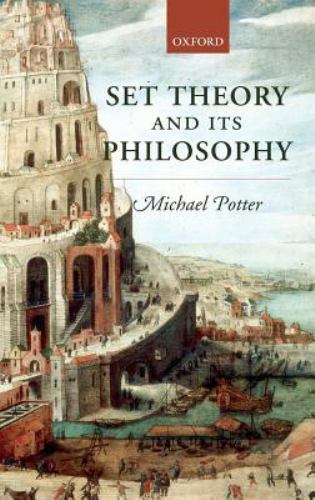
Set Theory and Its Philosophy : A Critical Introduction by Michael Potter (2004, Hardcover)

AlibrisBooks (500964)
99.2% positive Feedback
Price:
US $226.99
Approximately£171.51
+ $20.23 postage
Returns:
30 days return. Buyer pays for return postage. If you use an eBay delivery label, it will be deducted from your refund amount.
Condition:
New Hard cover
- Buy it nowSet Theory and Its Philosophy: A Critical Introduction by Michael Potter: New
Oops! Looks like we're having trouble connecting to our server.
Refresh your browser window to try again.
About this product
Product Identifiers
PublisherOxford University Press, Incorporated
ISBN-100199269734
ISBN-139780199269730
eBay Product ID (ePID)30509283
Product Key Features
Number of Pages360 Pages
LanguageEnglish
Publication NameSet Theory and Its Philosophy : a Critical Introduction
Publication Year2004
SubjectLogic, Set Theory
TypeTextbook
Subject AreaMathematics, Philosophy
AuthorMichael Potter
FormatHardcover
Dimensions
Item Height0.9 in
Item Weight23.1 Oz
Item Length9.2 in
Item Width6.1 in
Additional Product Features
Intended AudienceScholarly & Professional
LCCN2004-298369
Dewey Edition22
Reviewsa wonderful new book . . . Potter has written the best philosophical introduction to set theory on the market
IllustratedYes
Dewey Decimal511.3/22
Table Of ContentI. Sets1. Logic2. Collections3. The hierarchy4. The theory of sets5. ClassesII. Numbers6. Arithmetic7. Counting8. Lines9. Real numbersIII. Cardinals and Ordinals10. Cardinals11. Basic cardinal arithmetic12. Ordinals13. Ordinal aritmeticIV. Further axioms14. Orders of infinity15. The axiom of choice16. Further cardinal arithmetic
SynopsisMichael Potter presents a comprehensive new philosophical introduction to set theory. Anyone wishing to work on the logical foundations of mathematics must understand set theory, which lies at its heart. What makes the book unique is that it interweaves a careful presentation of the technical material with a penetrating philosophical critique. Potter does not merely expound the theory dogmatically but at every stage discusses in detail the reasons that can be offered for believing it to be true. Set Theory and its Philosophy is a key text for philosophy, mathematical logic, and computer science., Michael Potter presents a comprehensive new philosophical introduction to set theory. Anyone wishing to work on the logical foundations of mathematics must understand set theory, which lies at its heart. Potter offers a thorough account of cardinal and ordinal arithmetic, and the various axiom candidates. He discusses in detail the project of set-theoretic reduction, which aims to interpret the rest of mathematics in terms of set theory. The key question here is how to deal with the paradoxes that bedevil set theory. Potter offers a strikingly simple version of the most widely accepted response to the paradoxes, which classifies sets by means of a hierarchy of levels. What makes the book unique is that it interweaves a careful presentation of the technical material with a penetrating philosophical critique. Potter does not merely expound the theory dogmatically but at every stage discusses in detail the reasons that can be offered for believing it to be true. Set Theory and its Philosophy is a key text for philosophy, mathematical logic, and computer science.
LC Classification NumberQA248
All listings for this product


Be the first to write a review


